Tuesday, August 23, 2011

Our Children's World Is Magical

(This post, originally published at www.dadomatic.com, was inspired by my recent trip to Intel's Santa Clara Headquarters for their annual "Upgrade Your Life" Experience...)


"Any sufficiently advanced technology is indistinguishable from magic..." - Arthur C. Clarke
Of all the wonderful words that Clarke wrote, few have been as powerful and prescient as his frequently cited statement above. He was right.  More than right, he has defined the world we live in today, and more importantly, the world our children will carry forward. It is truly a magical world.

The Magic

In our lifetimes we have seen technology advance well beyond "sufficient," to provide us with tools and capabilities that are so indistinguishable from magic we already take them for granted. You wouldn't think twice about standing on a street in NY and speaking to your friend while they are on a boat off the coast of France...yet that is magic.  We take for granted that we can sit on the couch with a laptop or tablet and watch a movie sent to the device without wires or discs... yet that is magic.  Having near instant access to the answer to nearly any question imaginable, from a mobile device you carry in your pocket... is magic. Getting off a plane at crowded airport and getting a notification that a friend you haven't seen in person in years is also in the same terminal building, so you get to hang out together for ten awesome minutes... is magic.  I could go on and on.


The Magicians

Unlike the magic of wizards and sorcerers, the magic of technology cannot simply be invoked with incantations and chants of "abracadabra."  The magic of technology is created by a different type of magician - the engineers, scientists, visionaries and entrepreneurs who can not only envision the magic but who can also figure out ways to build it.  Today's magic comes from people and companies who have leveraged brainpower, innovation and imagination to make the impossible possible.  Chief among these modern day magicians is Intel. As an Intel Advisor I've had the privilege of taking a peek inside Intel and meeting many of the brains behind the magic and the wizards behind the curtains of innovations that have changed our lives and will change the lives of our children.

It's The Process, Not Just The Processor

What makes technology become magic is what it empowers us to do.  As amazing as it is to acknowledge the advancements and engineering prowess it has taken to facilitate the evolution of the microprocessor (following Moore's Law and decreasing in size while increasing in power and efficiency by silicon leaps and bounds), the true amazement is not in the chips, but rather in what the chips enable us to do.  Intel employs scientists, researchers, anthropologists, sociologists, even futurists, to study human behavior to better understand where the true power of the microprocessor can be put to work. In one day on the Intel campus for the Upgrade Your Life event we saw firsthand how technology is changing healthcare, education and the care of our environment.  We saw how technology is facilitating independent living for a rapidly growing population of seniors.  Magical things like placing sensors in chairs to wirelessly alert the wife of an Alzheimer's patient when her husband, known to wander off, gets up from his favorite chair, so she can come home from next door and make sure he is ok.  By using technology to place shift and skill shift aspects of healthcare, many of the services provided today by institutions can potentially be moved to the home, which for many could diminish the need for a nursing home.  The possibilities are endless, and the advancements are desperately needed as cost effective, and more importantly - effective healthcare is critical for an aging population.  We live longer, and the magic of technology may enable us to live better too.

Unleashing Human Potential

The talented artist Hugh MacLeod was hired by Intel to create some of his inspiring cartoons at the CES Show in January and he leveraged the phrase "The processor is an expression of human potential," which succinctly and sincerely captures the essence of the magic of technology.  While I don't mean for this to come off as just a puff piece for Intel, I do mean to use Intel as an example of one of the many companies that really are creating magic that will likely benefit our children in ways we can only begin to imagine.  Think of the world you lived in when you were the age your children are today.  How many of the things your children now take for granted would have seemed like magic to you back then?  I grew up in a world before there was a computer on every desk (and now in every pocket.)  My kids know no other world.  What is magic to me, is ordinary to them.

I can't wait to see the advancements that my kids won't be able to distinguish from magic!  Can you?

Disclosure: I am part of the “Intel Advisor” program and am compensated and/or receive other value from Intel to attend events on their behalf.  Intel covered my travel, accommodations and expenses for my trip to Santa Clara for the Upgrade Your Life event. 


Photo Credit: © ioannis kounadeas - Fotolia.com
Enhanced by Zemanta

Sunday, August 14, 2011

Long Term Relationships Are Not For Geeks


Before the geeks among you start attacking me, let me clarify.  I mean long term relationships with gadgets, not necessarily humans.  Take me, for example. Generally speaking, I'm a committed kinda guy.  Most places I have worked I was there for at least four or five years. I was married for sixteen years.  I'm currently in an eight year relationship. Not too shabby, right?  But when it comes to gadgets I am the complete opposite.  The proverbial seven year itch is more like a seven month itch.  This is especially true for phones. For the past ten years or more, I have changed my primary phone at least once a year.  As I work in the mobile industry, perhaps that's not so surprising, but what surprises me is the emotion I attach to each of my phones, and how quickly that emotion fades as soon as there's a new model in town.

Love the One You're With

I find I am always in love with my phone of the moment.  From Palm Treo, to HTC Touch Pro, to Palm Pre, to HTC Evo 4G, to my latest love, the Motorola Photon 4G... I was smitten with each and every one of them, from the OS to the bright pixels and silky touch of the glass screen as I swipe my finger across and tap the icon of a favorite app...  For all my lust and devotion, however, it always reveals itself to be a fleeting emotion, for I will inevitably soon have my wandering geek eyes on another.  A sneak peek at CES or CTIA, an early product announcement on TechCrunch or Engadget, and suddenly, I know in my heart of hearts that it is over, and a breakup is imminent.  As soon as I realize that my handheld mobile soul-mate may still be out there I begin to notice little flaws in my current mobile partner.  Screen swiping speeds that once wowed me suddenly seem sluggish.  The internal storage that seemed endless when our relationship began soon becomes far too little to fulfill my (app consumption) desires.  It's over.

Breaking Up Is (Not So) Hard To Do

I thought my HTC Evo 4G was my ideal mobile mate.  I adored the buxom 4.3 inch screen and flashy HTC Sense version of the Android OS. The allure of 4G was nice too, but alas, the dearth of coverage and demands on the battery life made 4G a minor attraction in our daily lives together.  Regardless, the Evo was a wonderful phone, and we were happier together than I had ever thought I would be, based on my prior phone relationships.  Though I began to notice other devices, I remained faithful to my Evo, and even resisted the temptations of the younger, slimmer, Evo 3D.  But then, the Motorola Photon arrived... and the reviews were good.  Dual core processor. Gorgeous screen.  Lighter, more appealing version of Motorola's MotoBlur software. And to top it off, the very latest version of Gingerbread.  She was sweet.  I had to have her.  I went to Radio Shack to see if she was there, and she was.  I put my Evo on the counter face down, and picked up the Photon.  It had me from "Hello Moto..."

How about you? Are you fickle with your phones too?  What kind of relationship do you have with your smartphone?

Photo Credit: NinaMalyna - Fotolia.com


(Affiliate Link)
Enhanced by Zemanta

Monday, July 25, 2011

Everything In Moderation: How To Give Good Panel

My mother always says, much to my embarrassment,
 "Jeffrey started talking in sentences when he was 10 months old... and he hasn't shut up since!" 
I suppose, if I am honest with myself, she is not entirely wrong, and I might be guilty of liking the sound of my own voice. Fortunately, throughout my life and career I've had the opportunity to speak publicly, whether on stage in a role (from the Cowardly Lion in a children's theater group production of "The Wizard of Oz" at age 10 to playing the role of Marcellus in a semi-pro production of "Hamlet" at Cornell at age 20) or in more recent years, speaking regularly at industry events and conferences. I truly enjoy public speaking, especially about topics I am passionate and excited about, and I try to bring a new challenge and experience to every presentation I give or panel I sit on.

The Moderator

Recently I had the opportunity to moderate a panel at the IAB Mobile Marketplace. This was actually my first time acting as the moderator. It was fun and rewarding, but very different from actually being the speaker or panelist. It was a new challenge and, determined to be successful, I spent a lot of time preparing, both with regard to the specific topic and questions for my panel, as well as researching the "art" of being a good moderator. As always, there were some great insights available online. I was particularly inspired by two blog posts on how to moderate a great panel, one by Jeremiah Owyang and the other by Guy Kawasaki. Both offered great practical advice that I took to heart and I think went a long way to helping make my first foray as "moderator" a successful one, and more importantly, making the panel successful at delivering valuable content in an engaging way, satisfying the paying audience. Here are some of the key things I learned from my experience moderating a panel, including some of the tips I utilized from Jeremiah and Guy:

1) Talk as little as possible. It is not about you (the moderator). It is about guiding the panelists and getting them to engage and reveal insights of value to the audience. You should never answer your own questions. Get the panelists to give the answers (by poking and probing them, if need be.) 
2) Meet with the panelists for 15 minutes or so just before going onstage. Remind them to speak to the audience and not to you. Review the gist of the questions you will be asking, but not all of them, as you will want some spontaneity. Remind them that is ok for them to disagree with each other (if that's what they believe) and they should feel free to jump in with differing opinions. In your "backstage" discussion, plant some seeds for good responses they can use, so the information will be fresh in their minds when you ask. 
3) If at all possible, sit on stage with the panelists rather than stand apart from them at a podium. It makes for more natural conversation and keeps the audience focused on where the action is. 
4) Use notes, and keep them on "old school" index cards. Keep notes and each of your potential questions on a separate index card. It is much easier to be subtle about having notes when they are on cards, rather than an iPad or other device (it is not about looking cool and current, it is about generating a great conversation). Index cards make it easy to casually flip through and decide on the next question based on the flow of the conversation. 
5) LISTEN, and therefore be prepared to disregard your notes and prepared questions. As moderator, you cannot afford to zone out thinking about your next question. You have to be actively listening to guide the conversation. If there is a lull, you need to be ready to step in and prod, or ask a new question to keep the momentum of the conversation flowing. If someone gives a general answer, don't be afraid to dive in and challenge them to be more specific. Ask them to "give examples" of what they mean. When one person is done answering, ask another panelist if they agree (especially if you know they are competitors or are likely to have different approaches.) 
6) Keep track of the time and don't be shy about cutting people off. At most conferences these days there is a clock or timer somewhere visible indicating the time remaining in the session. Audiences expect and deserve to have time to ask questions, and some of the best content gems often come as the result of audience questions. Agree beforehand with the organizers and panelists how much time you want to set aside for audience questions, and then it is your job to make sure to end the conversation and open the floor to questions at the appropriate time. If a panel ends with no time for audience questions, then the moderator has failed to be in control, and the audience will not have had the chance to fully benefit from the knowledge of the panelists.

Granted, I am a moderating newbie, but these are some of the things I gleaned and did my best to adhere to in the hopes of making my panel a successful one. In all, it was a great experience, and one I hope to repeat soon (as well as continue as a speaker and panelist.)

Do you agree with these suggestions? Do you have any other moderating tips you would add? Please contribute them in the comments.

Below is an excerpt from the Agency Buyers Panel I moderated at the 2011 IAB Mobile Marketplace.


Photo Credit: razihusin - Fotolia.com

Sunday, July 10, 2011

Taking Photography to the NEX Level « SONY make.believe

At the CES show back in January, Sony gave me one of their NEX-5 cameras, which has made me think differently about my own approach to digital photography... Some of the pictures I took with the NEX-5 are above and here is an excerpt from a post about it that I wrote for Sony's blog... Please visit http://blog.discover.sonystyle.com/taking-photography-to-the-nex-level to read the whole thing...

There’s a saying that the best camera is the camera you have with you… For many people today that means the camera in your phone. While the digital photography revolution began long before the camera phone became pervasive, for many, myself included, the advent of the camera phone was the thing that sparked a renewed interest in taking pictures. Somehow, just knowing I have that capability in my pocket, all the time, makes me look at the world through a different filter. It made me start looking for the pictures in everyday moments. But the more you start imagining the world as an image waiting to be captured, the more you realize that the camera in your phone is merely the gateway drug. It gets you hooked on digital photography, and, if the addiction sets in, invariably you’ll find yourself looking for something stronger.

Read the full post here.

Posted via email from Kiss My SASS!

Sunday, June 05, 2011

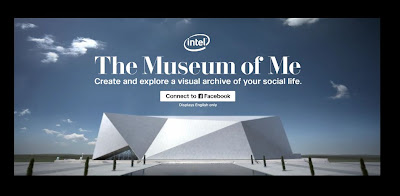
Intel's "Museum of Me" Puts YOU On Display


You've probably heard of "Moore's Law" named after Intel's co-founder Gordon Moore.  Moore predicted the exponential growth of processing speed, memory capacity and other aspects of computing devices and digital electronics that we have come to take for granted.  Intel itself has been abiding by Moore's Law, continually introducing new, faster, more efficient, and more capable microprocessors that power much of our digital lives.  At the same time, as technology becomes more and more of a commodity, it is important for companies like Intel to bring out the human side of their tech, and show consumers how smaller, faster, better, can actually be applied to the things we do with our digital tools and toys.

It's All About You

As a clever promotion for their 2nd Generation Core i5 processors, Intel has created "The Museum of Me," which slickly uses Facebook Connect to create a sleek and charming virtual walkthrough of The Museum of YOU!  Connect with your Facebook account and in a few moments you'll be the featured exhibit, with the museum walls adorned with your friends, photos, words and more.  It is a visualization of your social graph on Facebook that is guaranteed to put a smile on your face, and it is a great reminder of the "wow" factor a creative use of processing power can deliver.  Click here to get your Guggenheim on and march through your own private MOMA.  A day at the museum is always fun!


DISCLOSURE: I am part of the “Intel Advisor” program and am compensated and/or receive other value from Intel to advise and attend events on their behalf. 
Enhanced by Zemanta

Sunday, May 22, 2011

How Mobile Users Love Free: Let Us Count the Ways | DigitalNext: A Blog on Emerging Media and Technology - Advertising Age

"Free" is a four letter word. However, unlike the expletives often deleted, free is an "f" word that is embraced and enjoyed by millions of mobile content consumers who regularly download free music, videos, images, apps and games on their phones. Free content, supported or sponsored by advertising, is hardly a new concept. We have all grown up in a world where the "commercial break" is commonplace on TV and radio, and the American media consumer inherently understands that those commercials, like them or not, are facilitating the availability of quality entertainment, free of charge.

With the rapid rise of the rich-media-capable smartphone -- on course to soon comprise 50% of the U.S. mobile phone market -- we are consuming more and more of our entertainment directly on our mobile devices. Faster processors, larger, sharper screens, better networks, more data storage and the convenience of having it as a constant companion have made the modern smartphone wildly popular as a wireless entertainment hub. The smartphone is a true extension of the content-rich (read "free" content rich) internet we have come to rely on for entertainment as well as information. Thus, it is only natural that ad-supported mobile content is a viable and growing market.

Relevance vs. interruption
While mobile phone users are inclined to download free content rather than paid, they still don't necessarily want to be inundated with ads. Therein lies the rub for brands and mobile marketers. How can you subsidize mobile content in ways that consumers will accept, embrace and still value and act upon the advertisements associated with mobile content delivery?

One approach that has met with success for the ad-supported delivery of mobile music downloads, including MP3 full-tracks and ringtones, as well as images and videos, is to place relevant mobile ads within the SMS messages containing an item's download link, and put mobile banner ads on the mobile web download pages. These ads can be highly targeted and contextual, but they do not interfere with the actual content the user is downloading, and they do not add any steps to the download process. Such ads can reinforce a brand through association with the content and allow for click through, click-to-call, and other calls to action that don't prevent the user from obtaining the free content they desire.

Branded mobile content can also be ad-supported in a similar fashion, benefiting by targeting those consumers who already have an affinity for the brand, as expressed by their desire to download the brand's mobile content. Brands including Geico, Hefty, Skittles, Orbit and many more have effectively used branded mobile content to engage with consumers in ways that are lasting, impactful and easily shareable. In addition to the ad-supported delivery of branded content, the downloaded content itself remains on the user's phone as a reminder of the brand, and even as a conversation starter. A survey of Myxer users indicated that 81% keep downloaded content on their phones active for at least one week, and 52% for at least two weeks.

Knowing your target audience and their mobile behavior can also be useful to best leverage free mobile content for marketing and advertising purposes. For example, in an April 2010 study conducted by Myxer and issued in the BoomBox Report women accounted for twice as many mobile content downloads as men, and each female visitor to Myxer downloaded 17% more content than the average male. In general, campaigns around free mobile content have successfully increased brand awareness, brand favorability and purchase intent, while leaving consumers with downloaded content they could enjoy on their phone long after the "campaign" was over.

Share and share alike
Not only do consumers enjoy "free" themselves, but they also enjoy sharing "free" stuff with their friends. With that in mind, campaigns around free mobile content lend themselves well to a wide range of social sharing. Content items can be easily "liked" and shared on social networks such as Facebook and Twitter directly from mobile download pages.

In addition, rich mobile ad units can easily and directly interact with a brand's mobile social pages, making "free" mobile content both interactive and potentially viral. Conversely, free mobile content can also be offered within a widget directly from a brand's Facebook page, extending mobile beyond mobile and broadening the reach of free branded or sponsored content as well as the advertising around the delivery path.

For brands looking at ways to engage with mobile consumers, "free" can be a small price to pay for a successful mobile campaign.

ABOUT THE AUTHOR
Jeffrey Sass is VP-marketing at Myxer, a mobile technology company that operates Myxer.com, one of the largest providers of free, ad-supported mobile entertainment content.

Happy to see my article on "FREE" mobile content appear in AdAge DigitalNext...

Posted via email from Kiss My SASS!