Monday, July 25, 2011

Everything In Moderation: How To Give Good Panel

My mother always says, much to my embarrassment,
 "Jeffrey started talking in sentences when he was 10 months old... and he hasn't shut up since!" 
I suppose, if I am honest with myself, she is not entirely wrong, and I might be guilty of liking the sound of my own voice. Fortunately, throughout my life and career I've had the opportunity to speak publicly, whether on stage in a role (from the Cowardly Lion in a children's theater group production of "The Wizard of Oz" at age 10 to playing the role of Marcellus in a semi-pro production of "Hamlet" at Cornell at age 20) or in more recent years, speaking regularly at industry events and conferences. I truly enjoy public speaking, especially about topics I am passionate and excited about, and I try to bring a new challenge and experience to every presentation I give or panel I sit on.

The Moderator

Recently I had the opportunity to moderate a panel at the IAB Mobile Marketplace. This was actually my first time acting as the moderator. It was fun and rewarding, but very different from actually being the speaker or panelist. It was a new challenge and, determined to be successful, I spent a lot of time preparing, both with regard to the specific topic and questions for my panel, as well as researching the "art" of being a good moderator. As always, there were some great insights available online. I was particularly inspired by two blog posts on how to moderate a great panel, one by Jeremiah Owyang and the other by Guy Kawasaki. Both offered great practical advice that I took to heart and I think went a long way to helping make my first foray as "moderator" a successful one, and more importantly, making the panel successful at delivering valuable content in an engaging way, satisfying the paying audience. Here are some of the key things I learned from my experience moderating a panel, including some of the tips I utilized from Jeremiah and Guy:

1) Talk as little as possible. It is not about you (the moderator). It is about guiding the panelists and getting them to engage and reveal insights of value to the audience. You should never answer your own questions. Get the panelists to give the answers (by poking and probing them, if need be.) 
2) Meet with the panelists for 15 minutes or so just before going onstage. Remind them to speak to the audience and not to you. Review the gist of the questions you will be asking, but not all of them, as you will want some spontaneity. Remind them that is ok for them to disagree with each other (if that's what they believe) and they should feel free to jump in with differing opinions. In your "backstage" discussion, plant some seeds for good responses they can use, so the information will be fresh in their minds when you ask. 
3) If at all possible, sit on stage with the panelists rather than stand apart from them at a podium. It makes for more natural conversation and keeps the audience focused on where the action is. 
4) Use notes, and keep them on "old school" index cards. Keep notes and each of your potential questions on a separate index card. It is much easier to be subtle about having notes when they are on cards, rather than an iPad or other device (it is not about looking cool and current, it is about generating a great conversation). Index cards make it easy to casually flip through and decide on the next question based on the flow of the conversation. 
5) LISTEN, and therefore be prepared to disregard your notes and prepared questions. As moderator, you cannot afford to zone out thinking about your next question. You have to be actively listening to guide the conversation. If there is a lull, you need to be ready to step in and prod, or ask a new question to keep the momentum of the conversation flowing. If someone gives a general answer, don't be afraid to dive in and challenge them to be more specific. Ask them to "give examples" of what they mean. When one person is done answering, ask another panelist if they agree (especially if you know they are competitors or are likely to have different approaches.) 
6) Keep track of the time and don't be shy about cutting people off. At most conferences these days there is a clock or timer somewhere visible indicating the time remaining in the session. Audiences expect and deserve to have time to ask questions, and some of the best content gems often come as the result of audience questions. Agree beforehand with the organizers and panelists how much time you want to set aside for audience questions, and then it is your job to make sure to end the conversation and open the floor to questions at the appropriate time. If a panel ends with no time for audience questions, then the moderator has failed to be in control, and the audience will not have had the chance to fully benefit from the knowledge of the panelists.

Granted, I am a moderating newbie, but these are some of the things I gleaned and did my best to adhere to in the hopes of making my panel a successful one. In all, it was a great experience, and one I hope to repeat soon (as well as continue as a speaker and panelist.)

Do you agree with these suggestions? Do you have any other moderating tips you would add? Please contribute them in the comments.

Below is an excerpt from the Agency Buyers Panel I moderated at the 2011 IAB Mobile Marketplace.


Photo Credit: razihusin - Fotolia.com

Sunday, July 10, 2011

Taking Photography to the NEX Level « SONY make.believe

At the CES show back in January, Sony gave me one of their NEX-5 cameras, which has made me think differently about my own approach to digital photography... Some of the pictures I took with the NEX-5 are above and here is an excerpt from a post about it that I wrote for Sony's blog... Please visit http://blog.discover.sonystyle.com/taking-photography-to-the-nex-level to read the whole thing...

There’s a saying that the best camera is the camera you have with you… For many people today that means the camera in your phone. While the digital photography revolution began long before the camera phone became pervasive, for many, myself included, the advent of the camera phone was the thing that sparked a renewed interest in taking pictures. Somehow, just knowing I have that capability in my pocket, all the time, makes me look at the world through a different filter. It made me start looking for the pictures in everyday moments. But the more you start imagining the world as an image waiting to be captured, the more you realize that the camera in your phone is merely the gateway drug. It gets you hooked on digital photography, and, if the addiction sets in, invariably you’ll find yourself looking for something stronger.

Read the full post here.

Posted via email from Kiss My SASS!

Sunday, June 05, 2011

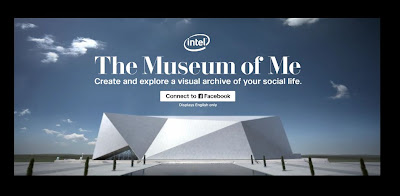
Intel's "Museum of Me" Puts YOU On Display


You've probably heard of "Moore's Law" named after Intel's co-founder Gordon Moore.  Moore predicted the exponential growth of processing speed, memory capacity and other aspects of computing devices and digital electronics that we have come to take for granted.  Intel itself has been abiding by Moore's Law, continually introducing new, faster, more efficient, and more capable microprocessors that power much of our digital lives.  At the same time, as technology becomes more and more of a commodity, it is important for companies like Intel to bring out the human side of their tech, and show consumers how smaller, faster, better, can actually be applied to the things we do with our digital tools and toys.

It's All About You

As a clever promotion for their 2nd Generation Core i5 processors, Intel has created "The Museum of Me," which slickly uses Facebook Connect to create a sleek and charming virtual walkthrough of The Museum of YOU!  Connect with your Facebook account and in a few moments you'll be the featured exhibit, with the museum walls adorned with your friends, photos, words and more.  It is a visualization of your social graph on Facebook that is guaranteed to put a smile on your face, and it is a great reminder of the "wow" factor a creative use of processing power can deliver.  Click here to get your Guggenheim on and march through your own private MOMA.  A day at the museum is always fun!


DISCLOSURE: I am part of the “Intel Advisor” program and am compensated and/or receive other value from Intel to advise and attend events on their behalf. 
Enhanced by Zemanta

Sunday, May 22, 2011

How Mobile Users Love Free: Let Us Count the Ways | DigitalNext: A Blog on Emerging Media and Technology - Advertising Age

"Free" is a four letter word. However, unlike the expletives often deleted, free is an "f" word that is embraced and enjoyed by millions of mobile content consumers who regularly download free music, videos, images, apps and games on their phones. Free content, supported or sponsored by advertising, is hardly a new concept. We have all grown up in a world where the "commercial break" is commonplace on TV and radio, and the American media consumer inherently understands that those commercials, like them or not, are facilitating the availability of quality entertainment, free of charge.

With the rapid rise of the rich-media-capable smartphone -- on course to soon comprise 50% of the U.S. mobile phone market -- we are consuming more and more of our entertainment directly on our mobile devices. Faster processors, larger, sharper screens, better networks, more data storage and the convenience of having it as a constant companion have made the modern smartphone wildly popular as a wireless entertainment hub. The smartphone is a true extension of the content-rich (read "free" content rich) internet we have come to rely on for entertainment as well as information. Thus, it is only natural that ad-supported mobile content is a viable and growing market.

Relevance vs. interruption
While mobile phone users are inclined to download free content rather than paid, they still don't necessarily want to be inundated with ads. Therein lies the rub for brands and mobile marketers. How can you subsidize mobile content in ways that consumers will accept, embrace and still value and act upon the advertisements associated with mobile content delivery?

One approach that has met with success for the ad-supported delivery of mobile music downloads, including MP3 full-tracks and ringtones, as well as images and videos, is to place relevant mobile ads within the SMS messages containing an item's download link, and put mobile banner ads on the mobile web download pages. These ads can be highly targeted and contextual, but they do not interfere with the actual content the user is downloading, and they do not add any steps to the download process. Such ads can reinforce a brand through association with the content and allow for click through, click-to-call, and other calls to action that don't prevent the user from obtaining the free content they desire.

Branded mobile content can also be ad-supported in a similar fashion, benefiting by targeting those consumers who already have an affinity for the brand, as expressed by their desire to download the brand's mobile content. Brands including Geico, Hefty, Skittles, Orbit and many more have effectively used branded mobile content to engage with consumers in ways that are lasting, impactful and easily shareable. In addition to the ad-supported delivery of branded content, the downloaded content itself remains on the user's phone as a reminder of the brand, and even as a conversation starter. A survey of Myxer users indicated that 81% keep downloaded content on their phones active for at least one week, and 52% for at least two weeks.

Knowing your target audience and their mobile behavior can also be useful to best leverage free mobile content for marketing and advertising purposes. For example, in an April 2010 study conducted by Myxer and issued in the BoomBox Report women accounted for twice as many mobile content downloads as men, and each female visitor to Myxer downloaded 17% more content than the average male. In general, campaigns around free mobile content have successfully increased brand awareness, brand favorability and purchase intent, while leaving consumers with downloaded content they could enjoy on their phone long after the "campaign" was over.

Share and share alike
Not only do consumers enjoy "free" themselves, but they also enjoy sharing "free" stuff with their friends. With that in mind, campaigns around free mobile content lend themselves well to a wide range of social sharing. Content items can be easily "liked" and shared on social networks such as Facebook and Twitter directly from mobile download pages.

In addition, rich mobile ad units can easily and directly interact with a brand's mobile social pages, making "free" mobile content both interactive and potentially viral. Conversely, free mobile content can also be offered within a widget directly from a brand's Facebook page, extending mobile beyond mobile and broadening the reach of free branded or sponsored content as well as the advertising around the delivery path.

For brands looking at ways to engage with mobile consumers, "free" can be a small price to pay for a successful mobile campaign.

ABOUT THE AUTHOR
Jeffrey Sass is VP-marketing at Myxer, a mobile technology company that operates Myxer.com, one of the largest providers of free, ad-supported mobile entertainment content.

Happy to see my article on "FREE" mobile content appear in AdAge DigitalNext...

Posted via email from Kiss My SASS!

Saturday, April 23, 2011

Happy Bard Day -er, Birthday, William Shakespeare!

William Shakespeare (1564-1616)Image via Wikipedia

(Today is the birthday of one William Shakespeare, and this post is in his honor.  My good friends, and wonderful people, AJ and Melissa Leon, are currently in England, working for the Shakespeare estate, and they have prepared an inspiring tribute to The Bard at www.happybirthdayshakespeare.com.  Please check it out, and my surprise appearance at the end of the video there, and embedded below.)

Around The Globe

The only time I visited the Globe Theatre it was the one in Stratford...Connecticut... not upon Avon. Even so, the class trip to the replica of the famed theatrical home to so many of Shakespeare's productions was a thrill for this young, aspiring writer and all around "theatrical" guy.  I was in the 10th grade, and already on a path that would lead me to be an "English & Theater Major" in college, fancying myself as someone who could write and perform well.  Well, at the time I had read many of the works of William Shakespeare and I had been enthralled by the powerful filmed performances of Sir Laurence Olivier, who was perhaps the physical embodiment of all things Shakespeare in my young impressionable mind.  But I had yet to see Shakespeare performed live, and for that reason I was eager and excited to hop on the chartered bus from Queens to Connecticut.

Weeding Out The Literary Types

The Connecticut version of the Globe Theatre was situated on beautiful, park-like property, with gorgeous shade trees and vast lawns of rolling greens. While I and a select few of my classmates were looking forward to the performance of the well respected American Shakespeare Theatre, an equally large bunch of my school trip mates were far more intrigued by the opportunity to wander off amongst the grass and trees to trip out on their own supply of a different grass.  My recollection is that I thoroughly enjoyed seeing Shakespeare performed live on stage at The Globe, and I sincerely hope that my enjoyment came from a love of words and the theatre, and not as a result of any contact high from my more adventurous classmates!

A Quaint Little Hamlet

Years later, I had the chance to actually perform in a semi-pro production of Hamlet at Cornell University.  It was a semi-pro production because us student performers were supplemented with a handful of professional "Equity" actors in the key roles, including the charming and talented John Hostetter, who went on to be a regular on the popular TV series Murphy Brown.  Our production was unique as we performed Hamlet in rotation with Tom Stoppard's delightful and clever "Rosencrantz and Guildenstern Are Dead," using the same set and actors in their overlapping roles.  So, the actors playing Rosencrantz and Guildenstern had minor roles in our Hamlet production one night, and were the stars of Stoppard's play the next.  It was a very clever and well executed concept.  I had a small, but impactful role, playing the part of the guard, Marcellus.

Line, Please!

Present, but silent, in a few key scenes, Marcellus is not much of an acting challenge... except for one line... perhaps THE line.  You see, Marcellus delivers perhaps one of the most famous and oft repeated lines in all of Shakespeare's words, words, words.  As Marcellus, I had to step out into the lights, armor clad, broad sword in hand, and muster every ounce of aspiring actor acumen I had to bring originality and authenticity to the well-worn phrase,

"Something is rotten in the state of Denmark!" 

It was quite a daunting task, and even if my performance bordered on being rotten itself, the experience was ripe with excitement, and memories I cherish to this day.

Thank you William Shakespeare, and HAPPY BIRTHDAY!


Enhanced by Zemanta

Sunday, April 10, 2011

The Best Of Your Life

A half mile longer today led to another milestone as I ran 5.5 miles along Hollywood Beach this morning.  I like to let my mind wander when I run, and my wandering mind arrived at a realization about how we can all truly be the best...  Watch the short video below and let me know if you agree!